How Coffee Waste & Plastic Bottles Now Fight Climate Change
Here’s something wild: that disposable coffee cup you tossed this morning and the plastic water bottle in your recycling bin could team up to fight climate change. No, seriously.
I know it sounds like science fiction, but researchers have cracked a code that’s been hiding in plain sight. They’ve figured out how to take two of the world’s biggest waste problems and merge them into something that actually pulls carbon dioxide out of the air.
Let me explain why this matters so much.
The Uncomfortable Truth About Our Waste Problem
We’re drowning in stuff we throw away. And I’m not being dramatic here.
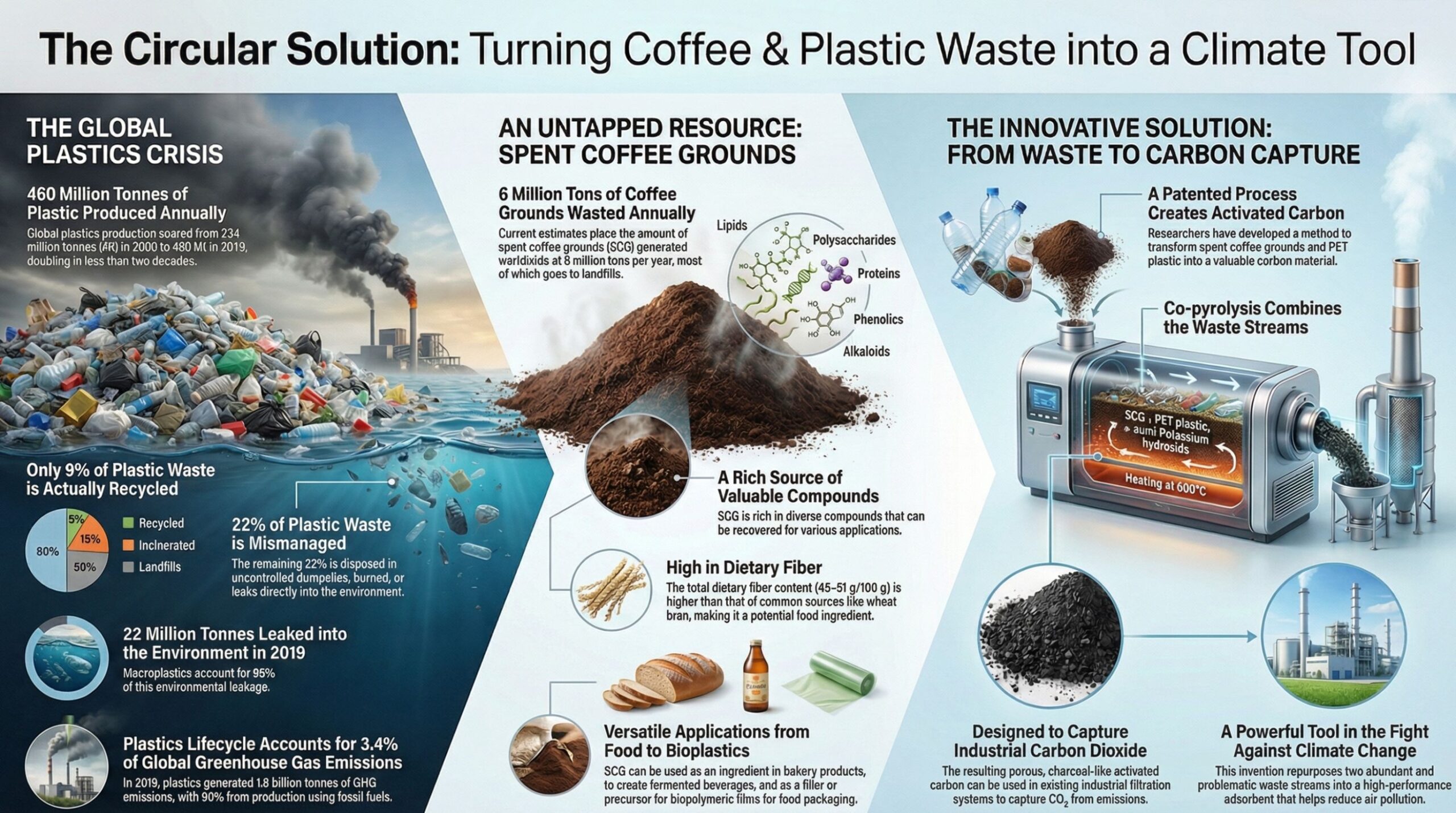
According to the OECD’s Global Plastics Outlook, we produced 460 million tons of plastic in 2019 alone. That’s almost double what we made in 2000. But here’s the kicker: we generated 353 million tons of plastic waste that same year.
Where does it all go? Brace yourself:
- Only 9% gets recycled (yeah, really)
- 19% is burned
- Almost 50% sits in landfills
- 22% ends up dumped illegally or leaked into nature
That last category? That’s 22 million tons of plastic ending up in our rivers, oceans, and forests every single year.
But plastic isn’t even the only villain in this story.
Coffee Grounds: The Waste Stream Nobody Talks About
Every morning, millions of us brew coffee without thinking twice about what happens to those soggy grounds left behind. Globally, we’re generating somewhere between 6 and 8 million metric tons of spent coffee grounds annually.
Most of it? Straight to the landfill.
Here’s the problem: when coffee grounds decompose in landfills without oxygen, they don’t just disappear. They produce methane and carbon dioxide – two greenhouse gases that are cooking our planet. So your innocent morning ritual is actually contributing to climate change, just in a way you never see.
I felt the same way when I learned this. But stick with me, because this is where the story gets really interesting.
When Two Wrongs Make a Right
Researchers at the University of Sharjah in the UAE asked a brilliant question: what if we stopped treating these materials like problems and started treating them like ingredients?
They developed a patented process called co-pyrolysis that combines spent coffee grounds with PET plastic (the kind in water bottles) and heats them together at 600°C. The result? Activated carbon – a super-porous material that acts like a sponge for CO₂.
Think of it this way: they’re taking the waste from your morning coffee and last week’s water bottles and transforming them into a material that can capture carbon dioxide from factory smokestacks before it reaches the atmosphere.
Lead inventor Haif Aljomard put it perfectly: “This invention repurposes two abundant waste streams – coffee and plastic – into a high-performance adsorbent.”
It’s a triple win that seems almost too good to be true.
Why This Actually Matters
This isn’t just a cool laboratory trick. It’s addressing three massive environmental crises simultaneously:
First, it gives plastic waste a purpose beyond sitting in landfills for centuries. We’re talking about material that currently contributes 3.4% of global greenhouse gas emissions throughout its lifecycle.
Second, it prevents millions of tons of coffee grounds from rotting in landfills and releasing methane – a greenhouse gas 25 times more potent than CO₂.
Third, and this is the beautiful part, it creates a material that actively removes carbon dioxide from industrial emissions. The very processes causing climate change can now be filtered through material made from waste.
The activated carbon can slot right into existing industrial filtration systems. No need to rebuild factories from the ground up. Just plug it in and start capturing carbon.
Coffee Grounds Are Having a Moment
This carbon capture innovation is just the beginning. Research published in the National Library of Medicine shows that spent coffee grounds are ridiculously versatile.
They’re packed with:
- Antioxidants that could end up in supplements
- Dietary fiber perfect for healthier baked goods
- Natural compounds that can be turned into biodegradable food packaging
Scientists have successfully added coffee grounds to biscuits and cakes (up to 4% without affecting taste) to boost fiber and antioxidant content. Others are extracting polysaccharides to create edible films that could replace plastic wrap.
It’s almost like coffee grounds are a Swiss Army knife of sustainability solutions that we’ve been throwing away this whole time.
The Bigger Picture: Rethinking Everything
Here’s what really excites me about this discovery: it’s not just about coffee and plastic. It’s about fundamentally changing how we think about waste.
For too long, we’ve operated on a “take-make-waste” system. We extract resources, turn them into products, use them briefly, then toss them. It’s a linear system on a planet with finite resources.
The circular economy flips that script. One industry’s waste becomes another’s raw material. What we throw away becomes the feedstock for something valuable.
The University of Sharjah’s innovation proves this isn’t just environmental idealism – it’s practical, patented technology that works right now.
What Happens Next?
The real question is: how do we scale this?
We need businesses to see waste not as a disposal problem but as a resource opportunity. We need investment in facilities that can collect, process, and transform these materials. We need policies that incentivize circular thinking over linear convenience.
And honestly? We need more people to know this is even possible.
Because here’s the truth: we’re not going to recycle our way out of the climate crisis with the systems we have now. But innovations like this – ones that address multiple problems simultaneously – give us a fighting chance.
Your morning coffee ritual and that plastic bottle don’t have to be environmental villains. With the right thinking and technology, they might just be part of the solution.
And that’s a story worth sharing over your next cup of coffee.
Sources:
- OECD Global Plastics Outlook 2022
- Spent Coffee Grounds Research – National Library of Medicine
- University of Sharjah
What do you think about turning waste into climate solutions? Have you seen other innovative approaches to the circular economy? Drop a comment below – I’d love to hear your thoughts.
Also read other articles :
- Why Coffee Makes You Poop Almost Instantly
- Mushroom Coffee Explained: Do the Health Claims Hold Up?
- Beyond Flavor: How Coffee’s Physical Effects Shape Long-Term Demand
Wong young low is a coffee industry journalist from China who has been writing since 2007, focusing on specialty coffee, roasting, and market trends. He writes based on field experience and supply chain observations – helping roasters and coffee businesses make more accurate and realistic decisions.