Development Time After First Crack: How Roasters Decide the Stop Point
In most roast rooms, development time is treated as a number to be managed. Seconds are counted, ratios calculated, and benchmarks compared. Yet despite the apparent precision, the decision of when to stop a roast after first crack remains one of the most interpretive and consequential choices a roaster makes.
This is because development time is not simply a phase on a roast curve. It is the point where chemical potential, physical structure, and market intent converge. The stop point after first crack ultimately defines how much of the coffee’s inherent potential is expressed, muted, or distorted.
Understanding development time as an art informed by systems, rather than a fixed rule, is essential for roasteries seeking both quality and repeatability.
Why Development Time Is Where Roasts Succeed or Fail
Before first crack, roasting is largely about preparation. Moisture is driven off, internal pressure builds, and precursor compounds are formed. After first crack, decisions become irreversible.
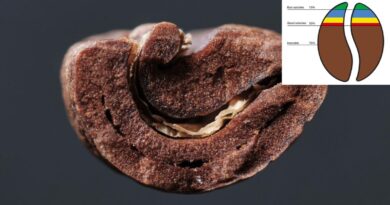
During development, sugars caramelize, acids transform, and aromatic compounds stabilize or degrade. Too little development and the coffee can taste sharp, hollow, or structurally incomplete. Too much, and origin character collapses into generic sweetness or bitterness.
What makes development time uniquely challenging is that it is highly sensitive:
- to green coffee chemistry
- to heat momentum entering first crack
- to airflow and environmental conditions
- to the intended brew method and market
A fixed post first crack rule cannot account for these variables.
The Myth of the “Correct” Development Ratio
Development time ratio (DTR) is widely used as a shorthand for control. While it can be a useful reference, it is often misunderstood as a target rather than a diagnostic.
Two roasts with identical DTRs can taste dramatically different if:
- one enters first crack with excessive heat momentum
- one stalls slightly before crack and recovers
- one coffee is high-density and another more porous
In practice, DTR does not explain why a coffee tastes the way it does. It only describes how long the final phase lasted relative to total roast time.
Roasteries that rely on ratios alone often struggle when green coffee changes or when scaling production. The number stays the same, but the flavour does not.
Development decisions must be anchored to sensory intent and roast dynamics, not percentages.
Heat Momentum Matters More Than the Clock
The stop point after first crack cannot be evaluated independently of how the roast arrives there.
A roast that carries excessive heat into first crack continues to develop aggressively even if heat is reduced immediately. Chemical reactions do not stop when the gas is turned down; they respond to accumulated energy.
Conversely, a roast that enters first crack with low momentum may require a longer development window to achieve structural completeness.
This is why experienced roasters talk about feel as much as numbers:
- How quickly does first crack progress?
- Does the crack sound sharp and rolling, or thin and scattered?
- How responsive is the coffee to airflow changes?
The art of development time lies in reading these signals and deciding whether the coffee needs restraint or support in its final moments.
Development Time Is a Risk Management Decision
From an operational perspective, development time is also about managing risk.
Short development windows often produce coffees with:
- narrow extraction tolerance
- high sensitivity to grind and water
- amplified acidity and volatility
These profiles may shine in controlled environments but struggle in wholesale or high-volume café settings.
Longer development tends to increase solubility and forgiveness, reducing the likelihood of extreme outcomes. The trade-off is reduced nuance and a narrower flavour range.
Choosing where to stop after first crack is therefore not only a sensory choice, but a commercial one. It reflects how much variability your market can absorb and how much control your downstream partners realistically have.
Green Coffee Sets the Boundaries
Not all coffees tolerate the same development approach.
High-density, high-acidity coffees often require careful, deliberate development to avoid harshness. Softer coffees may lose clarity quickly if pushed too far. Processing style also plays a role: washed coffees typically respond differently to development than naturals or anaerobics.
Attempting to force a uniform development strategy across diverse coffees is a common cause of inconsistency. The stop point should be informed by:
- bean structure and density
- processing clarity or fermentation intensity
- age and moisture condition
- intended flavour positioning
Development time does not create quality; it reveals or suppresses what is already there.
Sensory Cues Over Visual Cues
Many roasteries lean heavily on colour as a proxy for development. While colour is useful, it is an outcome, not a decision-making tool in real time.
During development, more reliable cues include:
- aroma evolution from sharp to rounded
- the transition from aggressive crack activity to tapering
- changes in exhaust smell indicating sugar browning
- The art lies in correlating these sensory cues with historical outcomes and market feedback, then refining the stop point accordingly.
This requires disciplined tasting and honest post-roast evaluation not just curve analysis.
Scaling Makes the Stop Point Harder, Not Easier
At small scale, a skilled roaster can adjust intuitively. At scale, the cost of inconsistency rises quickly.
Multiple operators, longer roast days, and tighter schedules reduce tolerance for subjective interpretation. Without clear guidance on why a roast should end where it does, teams default to time or colour targets.
Roasteries that maintain quality at scale translate the art of development into shared language:
- clear sensory references
- acceptable ranges rather than fixed numbers
- defined conditions that justify extending or shortening development
This does not eliminate judgment it aligns it.
A Practical Takeaway
The stop point after first crack is not a number to hit, but a decision to make.
It reflects how the roast arrived at that moment, what the green coffee can support, and what the market ultimately needs. Development time is where roasting shifts from execution to interpretation.
The most effective roasters do not ask, “What is the correct development time?”
They ask, “What does this coffee need, given how it has behaved so far and where it will be used?”
Answering that consistently is the real art behind development time.
Read other articles :
- Why the Same Roast Profile Fails Across Different Coffee Origins
- Managing Heat Transfer in Drum Roasting: What Roasters Miss
- Drum vs Air Roasters: Key Differences for Coffee Roasteries
- Roastery Website SEO: 5 Tricks to Boost Orders Fast
Follow us on :