
How to Maintain Roast Quality With Multiple Operators at Scale
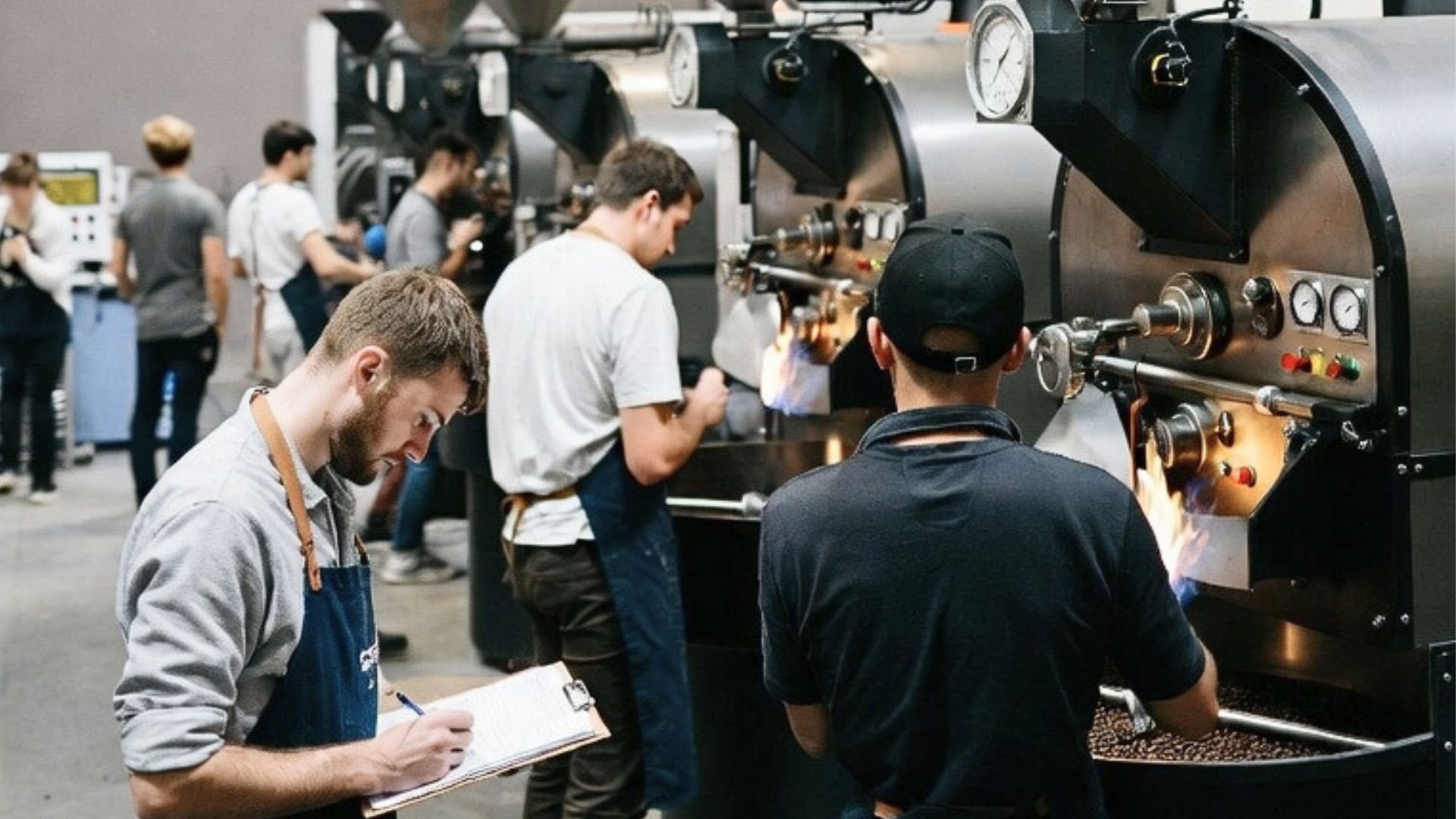
At small scale, roast quality often feels inseparable from the person at the controls. The same individual develops profiles, runs production, cups daily output, and makes adjustments intuitively. Quality is protected not by systems, but by proximity: problems are noticed immediately, discussed informally, and corrected in real time.
As soon as multiple operators enter the roast room, that model breaks.
Maintaining roast quality with multiple operators is not primarily a technical challenge. It is an organizational one. The core issue is not whether operators are skilled, but whether the system they operate within is designed to absorb human variability without translating it into flavor drift.
Roasteries that succeed at this do not eliminate differences between operators. They structure how those differences interact with profiles, machines, and decision authority.
Why Multiple Operators Expose Hidden Weaknesses
When a single roaster runs production, many decisions remain undocumented: how aggressively to respond to early rate-of-rise movement, how much deviation is acceptable before intervening, when to trust experience over the curve.
These decisions still exist with multiple operators. They are simply distributed.
Each operator brings their own calibration of risk, attention, and interpretation. Even with identical profiles, outcomes diverge because profiles never specify every decision point. They define targets, not judgment.
The mistake many roasteries make is assuming that inconsistency arises from operator error. In practice, inconsistency usually reflects ambiguity in the system. When expectations are unclear, operators fill the gaps differently and reasonably.
Quality begins to drift not because people are careless, but because the system asks them to make decisions without shared context.
Profiles Are References, Not Instructions
One of the most common failures in multi-operator environments is overconfidence in roast profiles.
Profiles are often treated as fixed instructions: follow the curve, hit the numbers, replicate the outcome. In reality, profiles are abstractions. They cannot encode machine behavior under different thermal loads, green coffee variation across deliveries, or environmental changes throughout the day.
Experienced roasters know this intuitively and compensate. Less experienced operators may follow profiles literally, even when conditions no longer match those under which the profile was developed.
Roasteries that maintain quality accept that profiles are starting points, not safeguards. They invest time in defining how operators are expected to interpret deviations, not just whether deviations occur.
This distinction matters more than tightening tolerances. Narrowing acceptable ranges without explaining how to respond to real-world variability often increases inconsistency, not reduces it.
Aligning Judgment Without Eliminating It
A common response to multiple operators is to restrict discretion: stricter SOPs, tighter controls, fewer adjustment options. While this can reduce visible variation, it often creates fragility.
When conditions fall outside defined parameters as they inevitably do operators hesitate. Decisions are delayed, or made mechanically, because the system has not clarified how judgment should be applied.
High-performing roasteries do the opposite. They make judgment explicit.
They define:
- Which decisions operators are expected to make independently
- Which require escalation
- What trade-offs are acceptable under time or production pressure
- Where consistency takes precedence over optimization
This does not standardize behavior. It standardizes intent. Operators may act differently, but they act toward the same outcome, with the same priorities.
Green Coffee Variability Becomes an Operator Issue
With one roaster, green coffee variability is absorbed quietly. With multiple operators, it becomes visible and often contentious.
Differences in density, moisture, or age require adjustment. If intake quality control and communication are weak, operators encounter variability without context. Each compensates differently, leading to inconsistent results that are blamed on execution rather than upstream management.
Roasteries that maintain quality across teams treat green coffee information as operational input, not background data. Intake notes, storage timelines, and known sensitivities are communicated clearly to the roast team.
When operators understand why a coffee behaves differently, responses converge. When they do not, inconsistency multiplies.
Machine Behavior Is Not Neutral
Roasting machines do not behave identically across shifts, operators, or production intensity.
Longer roast days introduce heat soak, slower recovery, airflow drift, and sensor lag. An operator starting the day inherits different conditions than one finishing it. Profiles developed under ideal conditions no longer map cleanly onto reality.
In single-operator environments, this is adjusted intuitively. With multiple operators, assumptions differ.
Some roasteries respond by re-profiling endlessly. Others address the real issue: capacity management. They define realistic batch limits, cooling intervals, and maintenance rhythms that stabilize machine behavior before asking operators to stabilize quality.
Consistency improves when machines are predictable. Expecting operators to compensate indefinitely for mechanical variability is a losing strategy.
Quality Control Must Influence Production Decisions
Quality control often exists in parallel to production, especially as teams grow. Cupping happens later. Feedback is aggregated. Corrections arrive after dozens of batches have already moved on.
At that point, QC becomes descriptive. It documents outcomes without shaping decisions.
Roasteries that maintain roast quality ensure that QC has operational authority. Feedback loops are short. Findings trigger action, not discussion. Operators understand how QC input affects profiles, schedules, or interventions.
This does not mean stopping production for every issue. It means defining which signals matter enough to change behavior in real time.
Without that clarity, operators default to throughput. Quality becomes aspirational rather than enforced.
Schedule Pressure Redefines “Good Enough”
As volume increases, time pressure reshapes behavior.
Stopping a roast, reworking a batch, or pausing to investigate carries a cost. Under pressure, operators recalibrate what is acceptable. Small deviations are noted mentally, not acted upon. Over time, this becomes the new normal.
This shift is rarely intentional. It is a rational response to constraints.
Roasteries that maintain quality design slack deliberately. They preserve time for intervention, build buffers into schedules, and acknowledge that consistency costs capacity.
Where no slack exists, quality control becomes symbolic. The system optimizes for output, not stability.
Training Is Not Calibration
Training new operators is often treated as skill transfer: how to run the machine, follow profiles, and read curves. Calibration shared understanding of quality targets and trade-offs is treated as implicit.
In multi-operator environments, this assumption fails.
Operators may be technically competent yet calibrated to different definitions of success. One prioritizes curve fidelity, another cup outcome, another schedule adherence. All are reasonable. Together, they produce inconsistency.
Effective training focuses less on mechanics and more on decision framing. Operators are taught not just what to do, but why certain outcomes matter more than others in specific contexts.
Calibration is maintained through ongoing dialogue, not one-time onboarding.
What Consistency Actually Requires
Maintaining roast quality with multiple operators does not require eliminating human variability. It requires designing systems that channel it.
Roasteries that succeed:
- Accept that profiles cannot replace judgment
- Make decision authority explicit
- Integrate green coffee information into daily operations
- Stabilize machine behavior before demanding consistency
- Give QC real influence
- Protect time for intervention
- Treat training as continuous calibration
Most importantly, they view inconsistency as diagnostic information, not failure. Drift signals that assumptions no longer hold that scale has changed the system.
A Practical Takeaway
The question is not whether multiple operators will introduce variability. They will. The question is whether that variability is absorbed, amplified, or managed.
Roasteries that maintain quality at scale do not rely on better people. They rely on clearer systems systems that recognize how humans actually make decisions under pressure, and are designed accordingly.
Maintaining roast quality with multiple operators is less about control and more about alignment. Where alignment is deliberate, consistency follows. Where it is assumed, it erodes quietly until customers notice.
Read other articles :
- Roastery Website SEO: 5 Tricks to Boost Orders Fast
- Five Coffee Lots That Changed Specialty Coffee Quality
- Green Coffee Purchasing Strategy for Roasteries Under Market!
- 7 Benefits of Caffeine for the Body and the Coffee Industry
- Consistency Tips for Roasteries Managing Multiple Origins and Lots
Follow us on :


