Drum vs Air Roasters: Key Differences for Coffee Roasteries
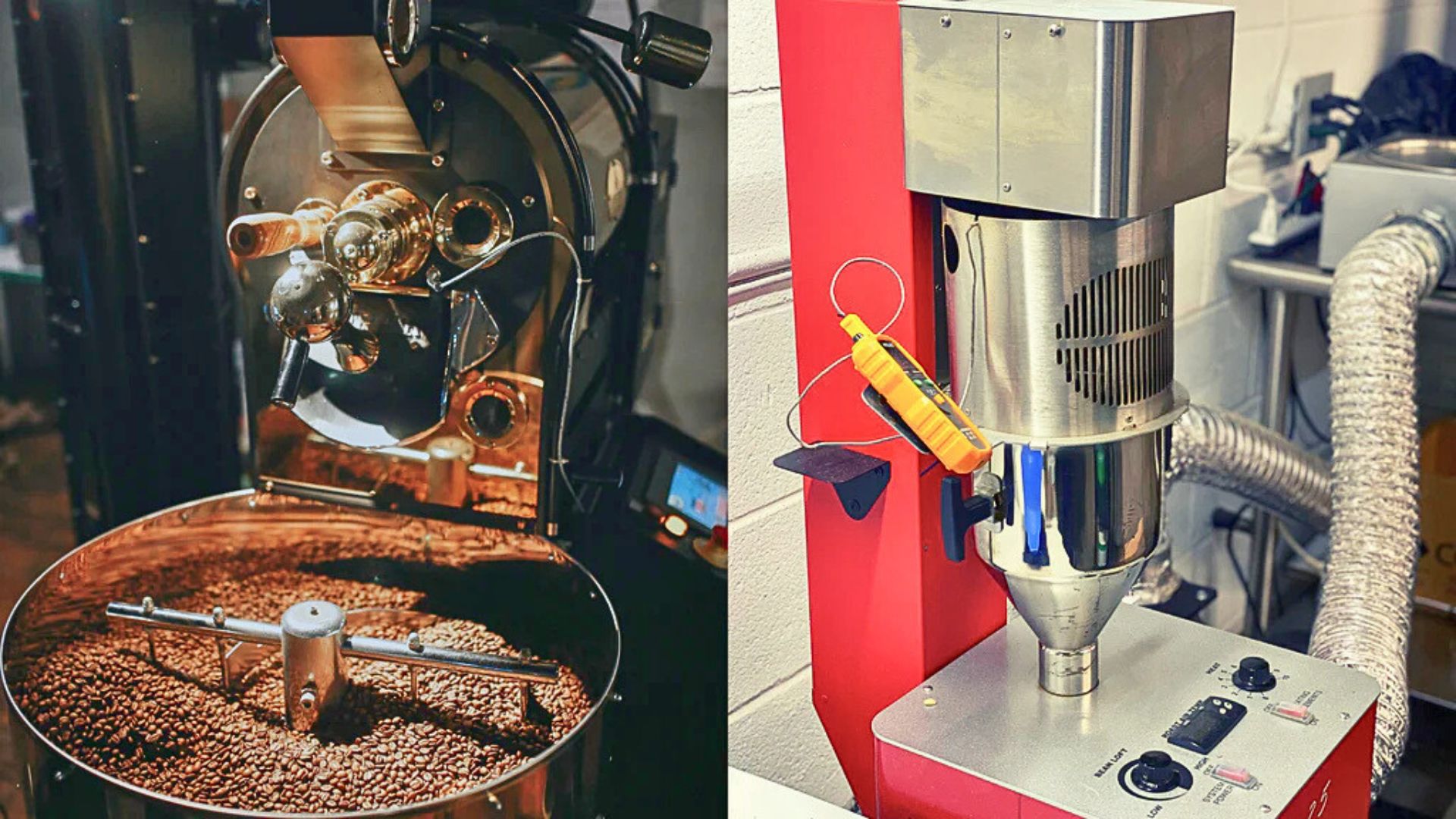
For most roasteries, the choice between a drum roaster and an air roaster is often framed as a matter of taste or philosophy. Drum roasting is seen as traditional and expressive, while air roasting is associated with precision and efficiency.
In reality, this decision has far-reaching implications. It affects flavor consistency, production capacity, energy use, maintenance costs, staff training, and long-term scalability.
Understanding how drum and air roasters actually work and where each excels or struggles is essential before committing capital, building roast profiles, or scaling production.
How Drum Roasters Work
Drum roasters use a rotating metal drum to tumble coffee beans while heat is applied, typically through gas burners.
Primary Heat Transfer Methods
- Conduction: Direct contact between beans and the hot drum surface
- Convection: Hot air moving through the drum
- Radiation: Heat emitted from the drum walls and flame
Because all three heat transfer modes are involved, drum roasting offers a complex and layered thermal environment.
What This Means in Practice
- Roast development is highly responsive to small adjustments
- Operators have wide control over airflow, gas, and drum speed
- Profiles can be shaped gradually, emphasizing sweetness and body
This complexity is why many specialty roasters value drum machines but it also introduces variability.
Read also: Espresso Machine Technology 2025: What Cafés Need to Knowa
How Air Roasters Work
Air roasters (often called fluid-bed roasters) suspend coffee beans in a stream of hot air, keeping them in constant motion without contact with a hot surface.
Primary Heat Transfer Method
- Convection only
Because beans are surrounded by hot air, heat transfer is:
- Faster
- More uniform
- More predictable
What This Means in Practice
- Rapid heat response to control changes
- Shorter roast times
- Minimal risk of scorching or tipping
Air roasters are designed around thermal efficiency and consistency, rather than manual expression.
Flavor Development: Expression vs Precision
Drum Roasters and Flavor
Drum roasters tend to produce:
- Greater perceived body
- Deeper caramelization
- More flexibility in stretching Maillard reactions
This makes them popular for:
- Espresso-focused roasteries
- Coffees where sweetness and mouthfeel are priorities
However, flavor outcomes depend heavily on:
- Operator skill
- Batch size consistency
- Environmental stability
Air Roasters and Flavor
Air roasters often highlight:
- Clarity and brightness
- Clean acidity
- Transparent origin character
They are well suited for:
- Filter-focused programs
- Light to medium roast styles
- High-throughput consistency
Some roasters perceive air-roasted coffees as lighter or thinner, though this is often more about profile design than the technology itself.
Consistency and Repeatability
Consistency is where air roasters often stand out.
Air Roasters
- Faster thermal feedback
- Less thermal inertia
- Lower batch-to-batch variance
This makes them ideal for:
- Multi-operator environments
- Contract roasting
- Wholesale programs requiring minimal deviation
Drum Roasters
- Greater thermal mass
- Slower response to changes
- Higher sensitivity to environmental factors
Well-managed drum roasteries can be extremely consistent, but achieving that requires:
- Strong SOPs
- Experienced operators
- Rigorous quality control
Read also : Coffee Packaging Design: Psychology of Color for Impulse Buying
Production Scale and Throughput
Drum Roasters
- Available in a wide range of sizes
- Common in mid to large-scale specialty roasteries
- Well-suited for long production runs
However:
Heat recovery between batches can slow throughput
Larger drums require careful energy management
Air Roasters
- Typically faster roast cycles
- Quicker cooldown times
- High output per hour relative to batch size
This makes air roasters attractive for:
- Growing roasteries with limited space
- Operations prioritizing efficiency over manual intervention
Energy Efficiency and Environmental Impact
Energy costs are increasingly central to roasting decisions.
Air Roasters
- Generally more energy-efficient
- Faster heat transfer reduces wasted energy
- Often paired with electric or hybrid systems
Drum Roasters
- Higher gas consumption
- Greater heat loss through metal surfaces
- Efficiency depends heavily on insulation and design
That said, modern drum roasters have improved significantly in efficiency compared to older models.
Maintenance, Wear, and Longevity
Drum Roasters
- Mechanically robust
- Long service life
- Require regular cleaning and bearing maintenance
Air Roasters
- Fewer moving mechanical parts
- Depend more on fans, sensors, and electronics
- Maintenance often centers on airflow systems
Neither system is inherently “low maintenance” they simply fail in different ways.
Training and Operator Skill
Drum Roasters
- Steeper learning curve
- Greater reliance on sensory judgment
- Operators influence outcomes more directly
Air Roasters
- More data-driven
- Faster onboarding for new staff
- Less variation between operators
This distinction matters for roasteries planning to grow beyond a small, founder-led team.
Cost Considerations
Initial cost varies widely by brand and size, but ownership cost should include:
- Energy consumption
- Maintenance
- Labor efficiency
- Product consistency
A drum roaster may offer greater expressive control, but an air roaster may deliver lower long-term operational risk.
Which Is Better for Your Roastery?
There is no universal answer.
Choose a drum roaster if your roastery:
- Prioritizes flavor development and expression
- Focuses on espresso or body-driven profiles
- Has experienced roasting staff
Choose an air roaster if your roastery:
- Prioritizes consistency and efficiency
- Operates at scale or plans rapid growth
- Focuses on filter coffee or wholesale reliability
Many successful roasteries eventually use both, assigning each to different production roles.
Read also : The Beginner’s Guide to Latte Art: 5 Practical Steps
Final Thoughts
Drum and air roasters are not competitors they are tools designed for different priorities.
Understanding how heat transfer, control, and production realities differ between the two allows roasteries to make decisions based on business needs, not mythology or tradition.
The best roaster is the one that aligns with your market, your team, and your long-term strategy.
Thank you for taking the time to read this article to the end. We hope it helped clarify the real differences between drum and air roasting and supports smarter decisions as your roastery grows.
Join the newsletter
Follow us on :