Tips for Starting and Growing a Coffee Roastery Business
Tips for Starting and Growing a Coffee Roastery Business. The coffee roasting sector serves as the strategic link between the unrealized potential of green coffee sourcing and the final experience of consumer consumption. It operates within a landscape defined by heavy capital investment, tight margins, and volatile commodity pricing. Success is driven not only by roasting skill, but by the ability to operate a sophisticated production system inside an unpredictable market environment.
Long-term sustainability requires a dual-focus strategy: achieving technical excellence the chemical and thermal precision needed to transform green beans into consistent products while simultaneously building a structured ecosystem of market relationships. This integration is what enables a roastery to move beyond a hobbyist operation and develop into a scalable, professional enterprise.
The Strategic Imperative
A unified approach that combines operational discipline with intentional relationship development acts as a buffer against equipment depreciation and market volatility. By positioning the roastery as a centralized source of expertise rather than a commodity supplier, the business reduces the risk of price-based competition. This roadmap outlines the progression from conceptual business design to operational maturity and market expansion.
Strategic Foundation and Business Architecture
The foundation phase is the single most influential factor in long-term scalability. Choices related to capital deployment, production capacity, and legal structure define the future operational limits of the business. Weak early planning often results in technical debt costly constraints that emerge when demand exceeds an inadequately designed infrastructure.
Integrated Startup Requirements
A scalable roastery depends on the alignment of physical infrastructure and intellectual capability. Core requirements include:
-
Skill Development and Accountability
Completion of reputable roasting education and training programs provides both technical grounding and professional credibility, enabling clear communication of value to experienced B2B clients. -
Infrastructure and Equipment Strategy
Selecting a production location optimized for workflow efficiency, along with machinery aligned to market goals (e.g., hot air systems for consistency or artisan-style machines for profiling flexibility). -
Brand Identity and Digital Presence
Establishing a coherent visual identity, professional website, and active social platforms to support credibility, discovery, and market entry. -
Human Capital Development
Building a team structure capable of maintaining quality standards as production volume scales.
The Business Plan as an Operational Framework
A business plan should function as a living operational guide, not a static document.
-
Market and Competitive Analysis
These insights inform equipment decisions. Large-capacity systems are necessary for wholesale distribution (grocery, hospitality, institutional clients), while smaller systems suit premium retail, boutique cafés, and direct-to-consumer channels. -
Financial Forecasting
Projections define inventory buffers, equipment ROI timelines, and expansion triggers guiding when to scale production or increase staffing capacity.
Pre-Production Stakeholder Checklist
Before initiating commercial roasting, the following foundations must be verified:
- Legal Structure & Finance: Registered business entity and dedicated corporate accounts
-
Permits & Compliance: Production licenses, food safety certification, emissions compliance
-
Insurance Coverage: Equipment, liability, and operational risk protection
-
Training Documentation: Verified roasting certifications
-
Infrastructure Readiness: Facility layout, machine installation, and utility validation
Operational Excellence: Quality, Inventory, and Technical Precision
In the coffee sector, consistency defines brand credibility. Operational excellence is achieved when a roastery can reproduce identical flavor outcomes across thousands of batches, regardless of environmental or supply-side variability.
Integrated Quality Management
Quality depends on disciplined control of both materials and process:
-
Green Coffee Supply Management
Partnering with transparent, reliable suppliers ensures consistency of input quality. Strategic inventory control tracking flow from purchase to roast prevents margin erosion from shortages, excess stock, or aging inventory. -
Storage Systems
Environmental stability for both green and roasted coffee is essential to preserving intrinsic quality and product value. -
Technical Execution
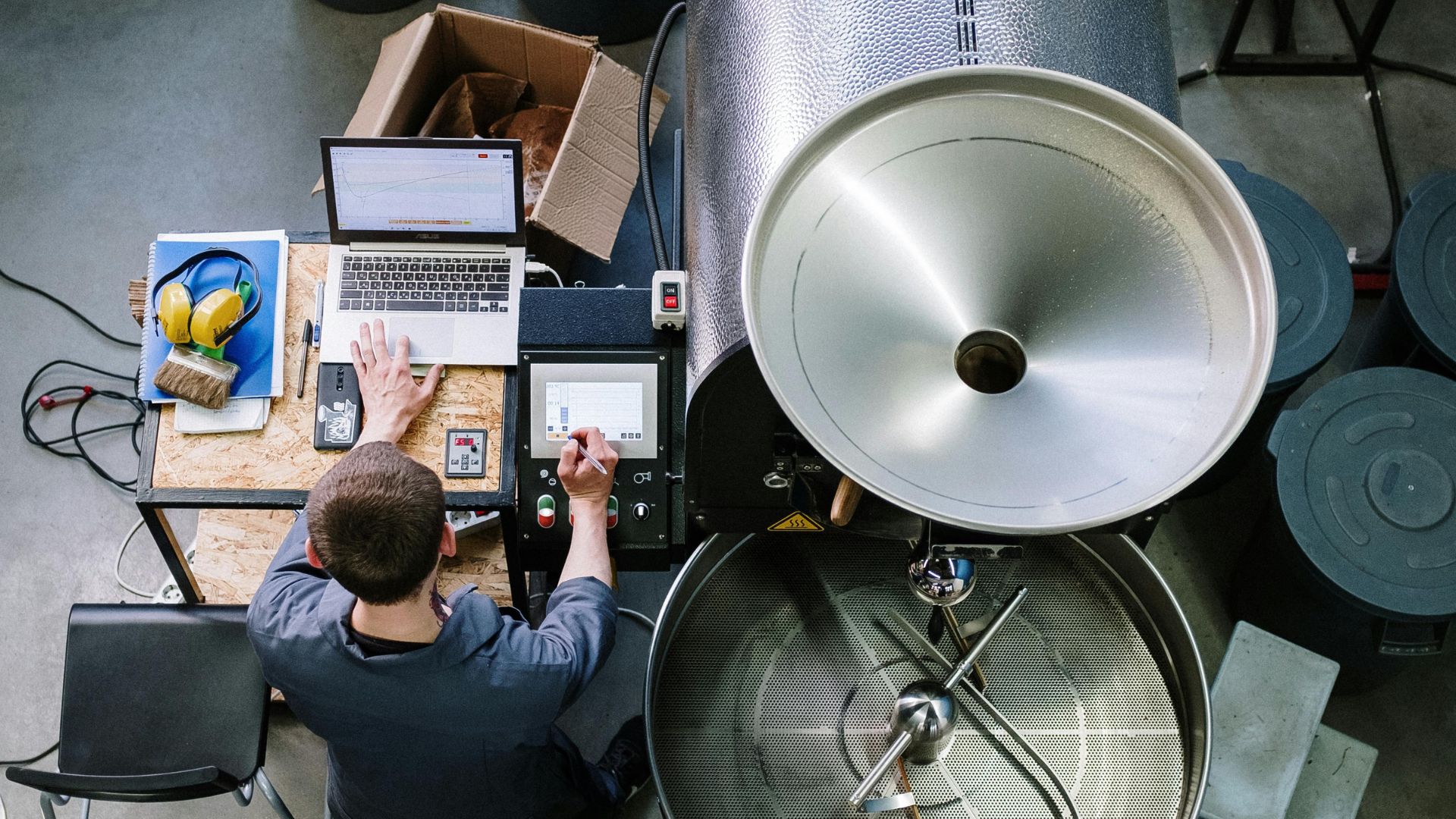
Mastery of roasting systems requires continuous calibration, testing, and analysis. The roaster must translate customer preferences into precise thermal profiles that reliably deliver expected sensory outcomes.
Consistency Control Protocol
To protect customer trust and retention, roasteries must implement structured consistency systems:
-
Green Bean Analysis
Track density, moisture content, and origin characteristics for every incoming lot. -
Profile Engineering
Develop tailored roast curves using controlled time, temperature, and airflow variables. -
Cupping and Transparency
Conduct regular sensory evaluations and share QC data and roast documentation with clients transforming quality control into a professional value deliverable.
Maintenance as Financial Protection
Preventive maintenance is not operational overhead it is margin protection. Sensor drift, calibration errors, and mechanical inefficiencies directly translate into product loss and wasted inventory. Proactive servicing and routine cleaning protect profit margins while extending the lifespan of high-value equipment assets.
Market Expansion and Relationship Ecosystems
Sustainable growth requires shifting from a product-centered model to a relationship-driven strategy. The objective is to evolve from supplier status into a core participant within a shared-growth network.
Capacity-Aligned Market Strategy
Equipment scale determines business structure:
-
Wholesale/Industrial Operations
Focus on logistics efficiency, volume throughput, and standardized output for hotels, retailers, and institutional buyers. -
Artisan/Small-Batch Models
Emphasize direct relationships, storytelling, specialty quality, and engagement with cafés, D2C customers, and home brewers.
Reciprocal Growth Systems
Growth accelerates when partners grow together:
-
Small Business Enablement
Supporting café partners with feedback, samples, and sales insights creates long-term loyalty. -
Educational Leadership
Hosting cuppings, barista training, and workshops establishes authority beyond supply. -
Community Integration
Active participation in coffee communities provides early access to trends and technical knowledge. -
Direct Consumer Engagement
Educational content and targeted promotions for home brewers diversify revenue beyond wholesale dependency.
The “One-Stop Solution” Advantage
A roastery that evolves into a service platform not just a producer creates competitive insulation:
-
Professional Materials: Structured catalogs and commercial-grade sales resources
-
Technical Services: Equipment consulting, installation guidance, and troubleshooting
-
Market Entry Strategy: Introductory pricing models that convert trials into partnerships
This positioning makes switching suppliers operationally difficult, not just financially inconvenient.
Strategic Resilience and Conclusion
Growth trajectories are rarely smooth. Equipment failures, market shifts, and supply disruptions are unavoidable. Resilience lies in maintaining long-term discipline solving problems without sacrificing quality for short-term survival.
The Five Pillars of Sustainable Success
A durable roasting enterprise is built on five interconnected foundations:
-
Quality : Controlled sourcing, storage, and production systems
-
Value Creation : Transparency, certification, and differentiated offerings
-
Knowledge Sharing : Education-driven authority within the ecosystem
-
Relationships : Mutual growth with partners and client trust
-
Market Strategy : Active customer acquisition across B2B and consumer channels
By aligning these pillars, a roastery evolves beyond craftsmanship into a resilient, scalable business platform positioned as a long-term strategic contributor within the global coffee value chain.
Read other articles :
- What’s Driving Coffee Market Uncertainty in 2026 | Industry Analysis
- Class Action Challenges Ethical Sourcing & Decaf Chemicals
- Drive-Thru Coffee Revolution | America’s Coffee Culture
Wong young low is a coffee industry journalist from China who has been writing since 2007, focusing on specialty coffee, roasting, and market trends. He writes based on field experience and supply chain observations – helping roasters and coffee businesses make more accurate and realistic decisions.